
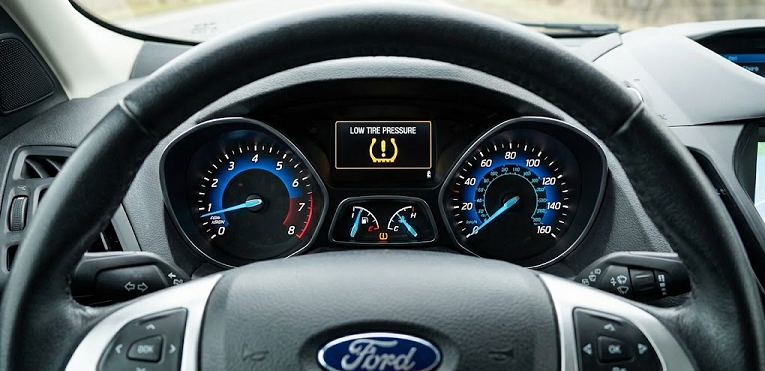
You climb into your Ford this morning, turn the key, and there it is—that glowing orange tire pressure warning light on your dashboard. Your heart sinks a little. Is it a flat? Did you run over a nail on Malabar Road yesterday? Should you even drive to work? Take a deep breath. If you’re in Palm Bay and it’s a chilly November or December morning, there’s an excellent chance your tires aren’t damaged. What you’re experiencing is something local Ford owners deal with every single year when our first cold fronts roll through Central Florida: the “Florida Cold Front Effect.” This phenomenon causes tire pressure to drop suddenly, triggering your TPMS (Tire Pressure Monitoring System) sensor even though you don’t actually have a leak or puncture. Understanding exactly why this happens—and knowing what to do about it—will save you unnecessary worry and help you keep your Ford running safely through our cooler months.
Don’t Panic: Your Tires (Probably) Aren’t Flat
Here’s the scenario that probably just happened to you: It’s early morning in Palm Bay, and overnight temperatures dropped from a comfortable 85°F down to the mid-50s as a cold front swept through Brevard County. You walk outside, start your 2023 Ford F-150 or your 2021 Escape, and immediately see that amber TPMS light staring back at you from the instrument cluster. The car feels fine when you back out of the driveway. The steering isn’t pulling to one side. You don’t hear any unusual thumping or flapping sounds. That’s because, in all likelihood, your tires aren’t flat at all—they’ve simply lost air pressure due to the sudden temperature change, and your Ford’s sensitive monitoring system is doing exactly what it was designed to do: alert you to the pressure drop.
This is an incredibly common occurrence for every vehicle on the road, from a 2010 Focus to a brand-new 2025 Bronco Sport. Modern Fords are equipped with highly accurate TPMS sensors that constantly monitor the air pressure in each tire, and they’re calibrated to warn you when pressure falls significantly below the manufacturer’s recommended level—typically triggering if the pressure drops 25% below the recommended PSI. When Palm Bay experiences one of those classic Florida cold snaps, with temperatures plummeting 20 or 30 degrees overnight, your tire pressure can drop enough to cross that threshold, triggering the warning light even though there’s no actual damage to the tire itself. The good news? This issue often resolves itself as the day warms up and your tires heat from driving, but there are smarter, more reliable ways to handle it than simply hoping the light goes away.
The Science: How the “Florida Cold Front Effect” Drops Your PSI
The physics behind this morning’s dashboard surprise is actually pretty straightforward, and understanding it will help you feel more confident about what’s happening under your Ford. Air pressure and temperature have a direct relationship: when temperature drops, air molecules slow down and take up less space, which means the pressure inside your tires decreases. The general rule is that for every 10-degree drop in ambient temperature, tire pressure drops by about 1 PSI. So if Palm Bay went from 85°F yesterday afternoon to 55°F this morning—a 30-degree swing that’s totally normal during our November and December cold fronts—your tires could have lost about 3 PSI overnight. Combined with normal air loss over time, that’s often enough to trip your TPMS sensor and illuminate that warning light on your dashboard.
What makes this particularly frustrating for Florida drivers is that we don’t typically experience the kind of gradual, seasonal temperature changes that folks up north deal with. Instead, we get sudden cold fronts that drop temperatures dramatically in just a few hours, creating a sharp pressure change that your Ford’s system immediately detects. Schedule a tire inspection if you want our technicians to verify your actual tire pressure and make sure everything is operating correctly, especially if this is the first cold snap you’ve experienced with your current vehicle. According to the National Highway Traffic Safety Administration, proper tire inflation is critical for safe handling, optimal fuel economy, and even tire lifespan—underinflated tires wear unevenly and can increase your stopping distance significantly, which is especially important on busy routes like US-1 or I-95 during morning rush hour.
Nitrogen vs. Air: The Secret to Combating Fluctuation
Here’s where things get genuinely interesting, and where you can actually prevent this annoying scenario from repeating itself every time a cold front moves through Central Florida. Most drivers fill their tires with regular compressed air, which is about 78% nitrogen and 21% oxygen, with trace amounts of water vapor and other gases mixed in. That water vapor is the problem. Moisture in regular air expands and contracts drastically with temperature changes, which amplifies the pressure fluctuations you experience during cold snaps. When temperatures drop in Palm Bay, that moisture condenses and takes up less volume, causing a more pronounced pressure loss than you’d see with a completely dry gas.
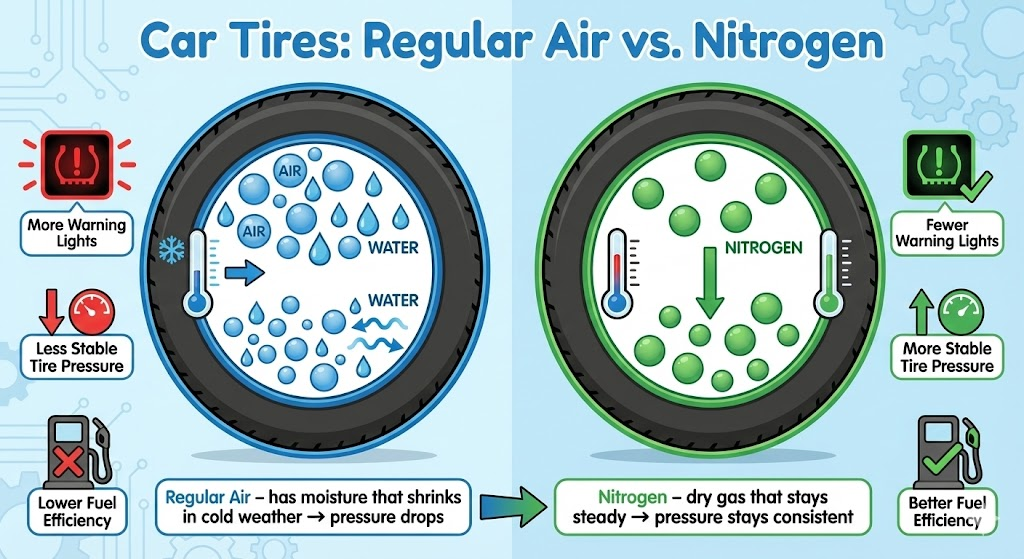
Nitrogen, on the other hand, is a dry, stable gas that doesn’t contain moisture, which means it maintains more consistent pressure during temperature swings. Racing teams have used nitrogen in performance tires for decades precisely because it reduces pressure variations, and now this same technology is readily available for everyday Ford drivers right here in Brevard County. When you fill your tires with nitrogen instead of regular air, you’re essentially reducing the moisture-related expansion and contraction that causes those frustrating morning TPMS alerts. While all gases respond to physics, your Ford Mustang’s performance tires, your Explorer’s all-seasons, or your Super Duty’s heavy-duty rubber will all maintain steadier pressure through Florida’s unpredictable weather patterns, meaning fewer surprise warning lights and more consistent handling and fuel efficiency.
How to Reset Your Ford TPMS Light (DIY Guide)
If you want to tackle this yourself before heading to the dealership, resetting your Ford’s TPMS light is actually pretty simple, and it’s worth trying to see if the warning was just a temporary cold-weather alert. For most Ford models from the past decade, the process works like this: First, make absolutely sure all four tires (and the spare, if your model monitors it) are inflated to the correct pressure listed on the driver’s door jamb sticker—not the maximum pressure stamped on the tire sidewall, which is a different number entirely. Once your tires are properly inflated, start your Ford and drive at speeds above 20 mph for at least two minutes. This gives the TPMS sensors time to recalibrate and recognize that pressure levels are back where they should be, and in many cases, the light will automatically turn off.
Newer Ford models like the 2022-and-later Explorer, Bronco, and F-150 typically utilize an auto-learn system that does not require a manual menu reset for daily adjustments. Simply driving the vehicle for a few miles allows the sensors to update automatically. However—and this is important—if the light stays on after you’ve properly inflated your tires and driven for several miles, you likely have a real puncture or a faulty sensor that needs professional attention. Don’t ignore a persistent TPMS light, because driving on a genuinely underinflated tire can cause serious damage and create unsafe handling conditions, especially on wet roads during one of Brevard County’s frequent afternoon rain showers. If the light persists, schedule a tire inspection immediately to rule out punctures or sensor malfunctions.
Why You Should Skip the Gas Station Air Pump
Let’s be honest: most of us have pulled into a gas station at some point, fed a few quarters into that grimy air compressor, and struggled with a dirty, stiff hose while trying to check tire pressure with a gauge that probably hasn’t been calibrated since the station opened. Gas station air pumps are notoriously inaccurate, often providing readings that are off by several PSI in either direction, which means you could easily overinflate or underinflate your tires without realizing it. Overinflated tires create a harsh, uncomfortable ride and reduce your contact patch with the road, while underinflated tires wear unevenly and waste fuel—neither scenario is ideal for your Ford, especially if you’re commuting daily between Palm Bay and Melbourne or making the drive up to Orlando on weekends.
There’s also the simple hassle factor: gas station equipment is often poorly maintained, the gauges are unreliable, and you’re left kneeling on dirty pavement trying to thread a valve cap back on while traffic whizzes by just a few feet away. Compare that experience to pulling into Palm Bay Ford Service, where our Quick Lane® technicians will provide a complimentary tire fill and pressure check using professional-grade equipment that’s regularly calibrated for accuracy. We’ll verify that each tire is inflated to your Ford’s exact specifications, inspect the tread for uneven wear or damage, and check your TPMS sensors to make sure they’re functioning correctly—all without you having to wrestle with a dirty air hose or guess at the right pressure. Our The Works package even includes a full tire rotation and pressure check to ensure even wear across all four corners, which maximizes tire life and keeps your Ford handling predictably through every season.
When Cold Weather Tire Pressure Drops Become a Real Problem
While most cold-weather TPMS alerts are harmless and temporary, there are situations where that warning light signals a genuine issue that needs immediate attention. If your tire pressure light comes on and stays on even after the day warms up and you’ve been driving for 20 or 30 minutes, that’s a strong indication you have a slow leak from a puncture, a failing valve stem, or a damaged wheel seal. Similarly, if the light is flashing rather than staying solid, that typically indicates a sensor malfunction rather than a pressure issue—the sensor itself may have a dead battery (they typically last 5-10 years) or have suffered damage from road debris or a pothole impact.
You should also pay attention to how your Ford handles when the light is on. If the steering feels heavier than usual, if the car pulls noticeably to one side, or if you hear a rhythmic thumping or flapping sound from one of the wheels, stop driving immediately and visually inspect your tires. These symptoms suggest a genuine flat or severely underinflated tire that could fail completely if you continue driving. Palm Bay’s roads can be tough on tires—between the occasional debris on Malabar Road, construction zones along Babcock Street, and the ever-present threat of a stray screw or nail in a parking lot—punctures happen, and it’s important to distinguish between a harmless cold-weather pressure drop and a real safety concern. When in doubt, our comprehensive tire maintenance services include thorough inspections, checking for leaks, testing sensor function, and examining tread condition to give you complete peace of mind.
The Hidden Costs of Ignoring Low Tire Pressure
Even if that TPMS light seems like a minor annoyance, consistently driving on underinflated tires creates a cascade of problems that quietly cost you over time. Underinflated tires increase rolling resistance, which forces your Ford’s engine to work harder to maintain speed, directly reducing your fuel economy. Studies show that properly inflated tires can improve gas mileage by up to 3%, which might not sound like much until you calculate what that means over a year of commuting between Palm Bay and your workplace in Melbourne or Viera. For a truck like the F-150 that already consumes more fuel than a sedan, that difference becomes genuinely noticeable at the pump.
Beyond fuel costs, underinflated tires wear unevenly and prematurely, with the outer edges of the tread deteriorating faster than the center. This uneven wear shortens tire lifespan significantly, meaning you’ll need to replace your tires thousands of miles earlier than you would have with proper inflation. Maintaining correct pressure through regular monitoring and adjustments makes solid financial sense and protects your long-term ownership costs.
Temperature Fluctuations and Tire Pressure: A Palm Bay Reality Check
| Temperature Change | Expected PSI Drop | Typical Palm Bay Scenario | TPMS Alert Likelihood |
|---|---|---|---|
| 10°F drop | ~1 PSI | Mild cool-down overnight | Low (unless already near threshold) |
| 20°F drop | ~2 PSI | Moderate cold front arrival | Moderate (depends on starting pressure) |
| 30°F drop | ~3 PSI | Strong November/December cold front | High (most vehicles will alert) |
| 40°F+ drop | ~4 PSI | Rare extreme cold snap | Very High (nearly all vehicles alert) |
Note: PSI drops are approximate and depend on initial tire pressure, tire size, and whether tires are filled with air or nitrogen.
Preventing Future Cold-Weather TPMS Alerts
The absolute best way to avoid waking up to that glowing orange warning light every time Brevard County experiences a cold front is to maintain your tires proactively rather than reactively. Check your tire pressure at least once a month using a reliable digital gauge—they’re inexpensive, easy to use, and far more accurate than the pencil-style gauges your dad probably used. Make it part of your routine, perhaps when you fill up for gas or wash your car on a weekend. Consistent monitoring allows you to catch small pressure losses before they trigger your TPMS and before they start costing you in fuel economy and tire wear.
- Upgrade to Nitrogen Fills: Reduce temperature-sensitivity issues that cause cold-weather alerts, giving you more stable pressure year-round regardless of Florida’s unpredictable weather swings.
- Check Monthly: Use a reliable digital gauge to monitor pressure before issues develop, especially during cold front season from November through February.
- Include Tire Inspections: Request full tire checks during routine maintenance visits, including pressure verification, tread depth measurement, and rotation scheduling.
- Monitor Weather Forecasts: When cold fronts are predicted for Brevard County, check your tire pressure the following morning to stay ahead of TPMS warnings.
- Keep Records: Track when you last rotated or replaced tires to ensure even wear patterns and maximize tire lifespan across all four corners.
Why Palm Bay Ford Service Is Your Best Choice for Tire Care
When it comes to maintaining your Ford’s tires and TPMS system, working with technicians who specifically understand Ford vehicles makes a meaningful difference. Generic tire shops and quick-lube chains may offer basic services, but they don’t have the Ford-specific training, diagnostic equipment, or genuine Ford parts that our dealership service department provides. Our technicians regularly work with every Ford model from the Maverick to the Super Duty, and they understand the unique TPMS calibration requirements, recommended tire pressures, and common sensor issues specific to each model year and trim level.
We use factory-spec diagnostic tools that communicate directly with your Ford’s computer system, allowing us to accurately identify sensor malfunctions, perform system resets, and ensure that all four sensors (or five, if your model monitors the spare) are functioning correctly and transmitting accurate data. When you need TPMS sensor replacements, we install genuine Ford sensors that are guaranteed to integrate seamlessly with your vehicle’s electronics, eliminating the compatibility issues that sometimes occur with aftermarket parts. Plus, our Quick Lane® service offers convenient hours and no-appointment-necessary tire fills and pressure checks, making it incredibly easy to swing by when that warning light catches you off guard on your way to work.
Frequently Asked Questions
Q: Will the TPMS light go off on its own when it warms up?
A: Sometimes it will, as driving warms the tires and increases pressure naturally. However, relying on this isn’t recommended—you should always verify the pressure manually to ensure your tires are properly inflated for safe driving.
Q: Is it safe to drive my Ford with the tire pressure light on?
A: If the car is handling normally and you don’t hear any unusual noises, it’s generally safe to drive carefully to the nearest service station or dealership. However, if you notice heavy steering, pulling to one side, or hear flapping sounds, pull over immediately and inspect your tires.
Q: How much pressure do my tires lose in cold weather?
A: The typical rule is about 1 PSI lost for every 10 degrees Fahrenheit the temperature drops. During a 30-degree cold front in Palm Bay, your tires could lose about 3 PSI overnight.
Q: Can I just ignore the light if my car drives fine?
A: Absolutely not. Even if the handling feels normal, underinflated tires reduce fuel economy, wear unevenly, and compromise your braking distance and emergency handling. Always address TPMS warnings promptly.
Q: How often should I check my tire pressure in Florida?
A: At least once a month is recommended, and always before long trips. During our cold front season from November through February, checking weekly is smart, particularly after overnight temperature drops.
Schedule Your Ford Tire Service at Palm Bay Ford Today
Don’t let unpredictable tire pressure warnings and Florida cold fronts stress you out every winter. The factory-trained technicians at Palm Bay Ford Service are here to keep your tires properly inflated and your TPMS system functioning flawlessly, whether you drive a brand-new Ford Bronco Sport or a trusted F-150 that’s been hauling your gear reliably for years. We have the specialized diagnostic equipment, genuine Ford parts, and expert knowledge to handle any tire or sensor issue quickly and correctly.
With Brevard County’s temperature swings creating consistent TPMS alerts from November through February, waiting to address tire pressure concerns only leads to unnecessary worry and potential safety issues on busy routes like US-1 and I-95. Our comprehensive tire service approach ensures your Ford maintains optimal pressure year-round, eliminating those frustrating morning dashboard surprises and giving you complete confidence every time you start your vehicle.
Click here to schedule your complimentary tire inspection and enjoy worry-free driving!
Or visit us at Palm Bay Ford Service, 1202 Malabar Road SE, Palm Bay, FL 32907, where our friendly team is ready to get your tires road-ready and keep you driving confidently through every Florida season.